Lightweight Shelving: Your Ultimate Guide to Organizing Your Space
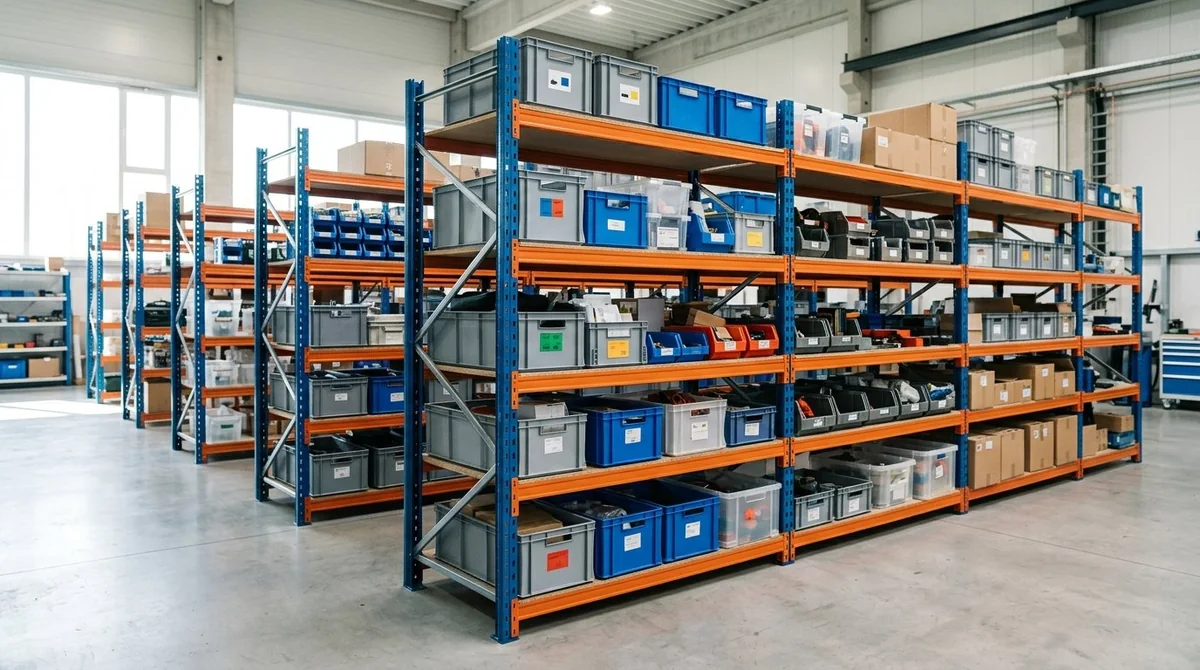
Lightweight shelving is defined as shelving that is loaded and unloaded by hand. This is not a commercial label; the European standard for warehousing terminology, EN 15878, uses the term "manual handling shelving" to distinguish it from systems operated with forklifts. This distinction determines everything else: dimensions, weight capacity, anchoring methods, and applicable regulations.
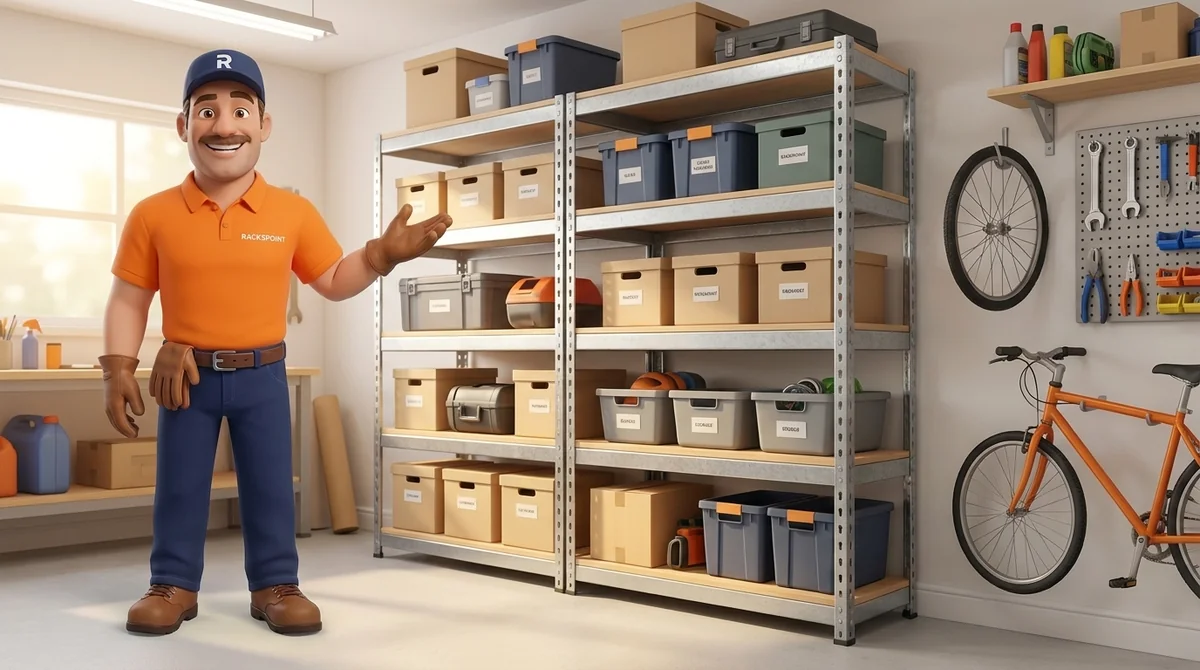
In our catalogue, this product family is represented by the URBAN range of lightweight shelving: 180 cm high by 90 cm wide, with five levels and a capacity of 175 kg per shelf, available in depths of 30 and 40 cm. A 60 cm depth is available, but only in the wheeled version. Models with MDF shelves do not all have the same load capacity: the white 180x90x40 cm model maintains five levels and 175 kg per shelf, while the galvanized 150x70x30 cm model has a capacity of 150 kg per level. The 160x80x40 cm model has four levels instead of five, also with a 150 kg capacity per level.
What Can Lightweight Shelving Really Hold?
What Does "175 kg Per Shelf" Mean, and What is the Total Capacity of the Unit?
It means 175 kg on each of the five levels, with the load distributed evenly across the entire surface of the shelf. The total capacity you will see published, 875 kg for the 180x90 cm model, is the sum of these five levels; it does not authorize you to double the load on one shelf and leave the others empty. For the 150 kg versions, the same calculation yields 750 kg with five levels and 600 kg with four; these total figures are our own calculations, not published data on the product sheet.
"Uniformly distributed load" is how it is stated on our product sheets, and this is a manufacturer's criterion, not a regulatory requirement. A concentrated load – such as an engine in the centre or a box of screws on an edge – is handled differently than the same weight spread across the entire shelf. In practice:
- Weigh a full box before multiplying by five; most people underestimate the weight.
- If an item is heavy and takes up little space, place it on the bottom shelf and use a board to distribute the support.
- Allow for a margin: operating below the advertised load capacity extends the lifespan of the shelf.
Depth is the Key Measurement for Stability
The height and width are chosen by looking at the wall; the depth is determined by what you intend to store and the effort required to maintain stability.
What Depth is Suitable for a Garage, Storage Room, or Archive?
A 30 cm depth is suitable for folders, binders, paint cans, and screws, making it ideal for small shops and office archives. A 40 cm depth can accommodate standard moving boxes and hand tools, making it the most balanced option for a storage room. The 60 cm depth, available only in the wheeled version of this range, is ideal for large boxes, spare tyres, and suitcases.
An old trade rule of thumb, which is indicative rather than mandatory, can be used for selection: shelving loaded and unloaded by hand can be considered stable if the height of the top loaded shelf does not exceed five times its depth. Taking the top loaded shelf near the top of the shelving unit, which is the conservative approach:
- 180 cm high with 30 cm depth: The ratio is 6:1, exceeding the guideline. Anchor it to the wall or reserve the top two levels for lighter items.
- 180 cm with 40 cm depth: 4.5:1, within the guideline.
- 180 cm with 60 cm depth: 3:1, with ample margin. Note: this is the wheeled version, which is not anchored, so use this margin by loading heavier items on the bottom.
- The smaller MDF units perform better: the 150x70x30 cm unit has a ratio of exactly 5:1, and the 160x80x40 cm unit has a ratio of 4:1.
This same criterion recommends securing them to the wall or a fixed structural element. Industry guides often mention appropriate anchoring without specifying to what. The manufacturer is responsible for providing this detail; follow their instructions.
Straight, L-Shaped, U-Shaped, Corner, or Wheeled
The URBAN range is purchased in modules and configured as follows:
- Straight, 1 to 4 modules. The standard configuration: free wall space and 90 cm width per module.
- L-Shaped, right or left corner. Solves corner spaces without the dead space created by facing two straight units.
- U-Shaped. For narrow storage rooms: utilizes three walls and leaves central access.
- Corner Unit. A standalone corner module to complete an existing installation.
- Wheeled, 180x90x60 cm. For items that need to be moved: consider wheeled shelving if you frequently reconfigure your space.
All units assemble without screws, by interlocking the parts, and the galvanized finish protects the metal against corrosion. The collection is categorized under garage shelving, with finishes available in galvanized, white, grey, black, and chrome.
What Regulations Apply to Lightweight Shelving in a Garage?
No workplace safety regulations apply, and it's important to state this clearly as it's a common point of confusion. Workplace safety regulations govern work environments, and a residential garage or storage room falls outside of these. The European warehousing standards often cited do not apply either: EN 15635, concerning use and maintenance, expressly excludes domestic storage, and EN 15512, on design, is for conventional pallet racking and explicitly excludes manual handling shelving.
What does apply at home is general product safety: Regulation (EU) 2023/988, applicable throughout the European Union since December 13, 2024, requires manufacturers to provide clear safety instructions and information with their products, in a language easily understood in the country where they are sold. These instructions are your regulation. The specific calculation code for this product is not an EN standard; it is FEM 10.2.06, "Design of Hand Loaded Low Rise Steel Static Shelving," from the European industry association, which is a paid document and not mandatory.
What If I Install It in a Shop, Workshop, or Office Archive?
Then the framework changes because workers are involved, and the workplace safety regulations of the country where it is installed apply. In varying terms, the requirements generally revolve around the same principles: assembly following the manufacturer's instructions, stabilization through anchoring or other means, an initial inspection after installation and before commissioning, and ensuring that passageways and circulation routes are free of obstacles and have sufficient width for anticipated traffic. In other countries, equivalent regulations apply, which you must consult.
Industry guides are often cited, and they are written for conventional pallet racking metal shelving. Their rules can be adapted to shelf shelving as a professional guideline, never as a mandatory requirement: these guides are declared as recommendations, not mandatory unless incorporated into current legislation. The European general product safety regulation is valid in all our markets.
Seven Usage Rules You Can Apply Today
Adapted from good warehousing practices:
- Level before loading. A sloping floor can misalign uprights and cause shelves to rest improperly.
- Heaviest items at the bottom. Place the heaviest objects on the lower shelves and lighter items on the upper shelves.
- Respect the maximum permissible load of the storage system and avoid overloading.
- Distribute the weight across the entire shelf rather than concentrating it in the centre or on an edge.
- Never climb on the shelves. Shelf shelving is not designed to support a person, and this applies at home just as it does in a warehouse: use a ladder.
- Do not modify the unit by cutting uprights or improvising shelves from another model. If you reposition shelves, do so with the unit empty.
- Keep the instructions and note the load per level where it is visible. This sign should preferably be placed on the unit headers; in a shared storage area, a marker pen is sufficient.
And a limitation that concerns the user, not the shelving: manual handling of loads has a recommended maximum weight, which is not a single figure as it depends on the height at which the load is gripped, the frequency of the action, and the individual lifting. Ideal conditions are when the load is close to the body, at hip height, and with a straight back; the further you deviate from these conditions, the less weight the action can safely handle.
When Does Lightweight Shelving Become Insufficient?
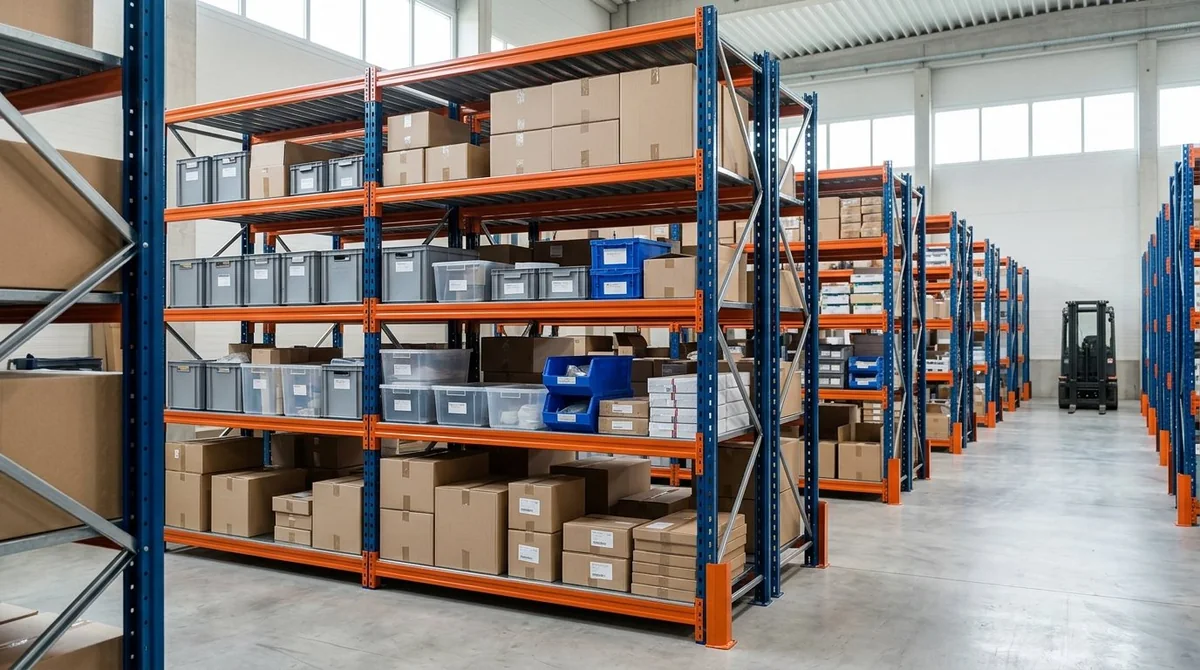
When you regularly exceed 175 kg per level or when you need more width than a 90 cm module provides. This is where medium-duty shelving begins, with capacities of 200 kg per shelf in the ProSpan 200x200x60 cm model, 275 kg in the ProRack 180x120 cm, and 300 kg in the Pro Glide. Above this is heavy-duty shelving, with 600 kg per level in the Titan C-Beam and 800 kg in the Titan Span. And if you move pallets with a pallet truck or forklift, it is no longer shelf shelving but pallet racking, which is a different product and falls under a different regulatory framework.
For most garages, storage rooms, and archives, a well-chosen lightweight shelving unit – with the correct depth, anchored where necessary, and loaded from bottom to top – will last for years. If you are unsure between two depths, please contact us with the dimensions of your space.