Heavy Duty Shelving: Load Capacity and Usage Guidelines

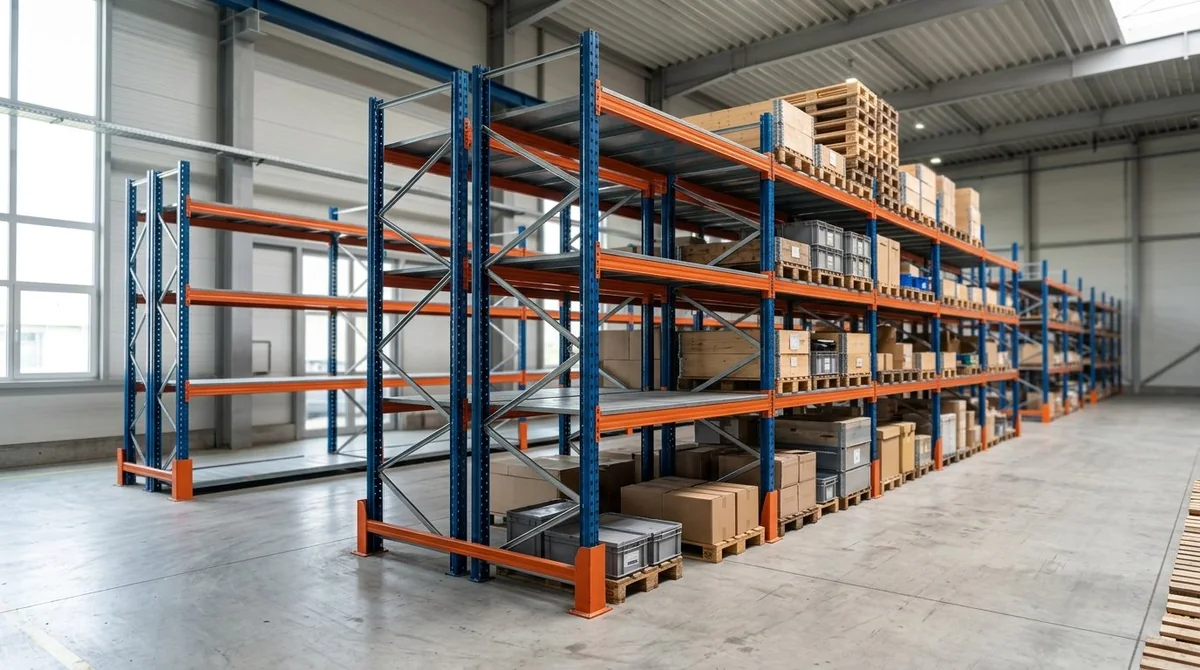
A heavy duty shelving unit is a continuous shelf racking system for placing and retrieving goods by hand or with a pallet jack: boxes of parts, drums, large tools. Choosing the right one depends not only on weight but also on how the load is handled and the available space. The SP Titan family offers two models: the Titan C-Beam, measuring 180 × 150 × 60 cm with four levels each supporting 600 kg and a silver-grey epoxy paint finish, and the Titan Span, measuring 250 × 200 × 60 cm with four levels each supporting 800 kg, in blue and orange. Both assemble without screws, with frames and beams slotting together, and feature height-adjustable shelves: if your operations change, the levels can be repositioned.
Do I Need Shelving or a Pallet Racking System?
The deciding factor isn't the total warehouse weight, but how the goods are handled.
- If goods enter and exit in full pallets moved by a forklift: you need a pallet racking system, without shelves and with beams where the forklift places the entire load unit.
- If you handle boxes, individual parts, drums, or tools, one by one: continuous shelving is required, and these two models are designed for that.
How Much Weight Can Each Shelf Hold, and What's the Total Capacity?
The key figure is always per level: 600 kg for the C-Beam and 800 kg for the Span, with the load distributed evenly across the shelf as per the manufacturer's instructions. This capacity is determined by the configuration of the uprights, the type of beams, and the material of the support surface. It's certified for uniform distribution: concentrating the load at one point will cause significantly more deflection of the profile, leading to permanent deformation or, if continued, structural collapse. If you have a single, very heavy item, place it near the uprights.
A word of caution: the load per level does not multiply by the number of levels to determine the maximum capacity of the entire unit; this is an arithmetic sum, not a structural calculation for the frame. The load per frame is declared by the manufacturer, and for these two models, it's not published. If you plan to load all four levels to their maximum simultaneously, please consult us before purchasing. Always check the technical data sheet before loading the first level to ensure the certified limit is not exceeded.
Is the 180 cm or 250 cm Unit More Suitable for Me?
Two factors are important, and neither is ceiling height. Firstly, consider who will be loading the top level: at 250 cm, the highest shelf is well above shoulder height, so it's only suitable for light, bulky items, requiring a stable ladder and no climbing on the shelving. Secondly, consider the usable width: the 200 cm width of the Span can accommodate long items that would need to be split into two spaces on the 150 cm C-Beam. Narrower widths allow for more modules in the same linear space.
You also need to measure your ceiling height: 250 cm plus clearance for maneuvering above. With a 60 cm depth on both units, avoid letting items overhang the front: the weight hanging outside is not distributed.
Can They Withstand the Humidity of a Garage or an Unheated Warehouse?
The Span's datasheet advises avoiding prolonged humidity and cleaning with a damp cloth, without aggressive chemicals. This is a manufacturer's instruction, not a corrosion resistance classification: neither unit declares such resistance. If you anticipate condensation or splashing, consult us beforehand.
Where Should Different Weights Be Placed on the Shelving?
Place heavier items on lower shelves for two reasons: it keeps the center of gravity low and prevents the most common cause of overloading, which is placing the heaviest loads on upper levels along with poor distribution of load units.
The other limitation is not of the shelving itself, but of the person loading it. Manual handling has a recommended maximum weight that isn't a single figure: it depends on the height at which the item is grasped, the frequency of the action, and the individual performing it. This is calculated for ideal conditions—load close to the body, at hip height, with a straight back—and decreases the further away or higher the grip is; loads should never be lifted above head height. On a 250 cm Span unit, the top shelf is at just that height: it's a place for light items.
How is it Assembled, and Does it Need to be Anchored to the Floor or Wall?
The screw-free assembly is quick, which is why it's important to do it carefully: a partially engaged beam may not be visible once loaded. Check for plumbness before placing any weight, ensure all four feet are resting evenly, and that each beam is fully seated. Level the unit with rigid shims.
Anchoring deserves a separate discussion because a commonly misapplied rule circulates: in pallet racking, units are fixed only to the slab and never to walls or other building structures, to prevent force transmission between them, unless the design documentation expressly states otherwise. This rule applies to racks served by forklifts—it addresses a problem that hand-loaded shelving doesn't have—and its exception opens the door: the C-Beam datasheet recommends wall fixing, while the Span says nothing about anchoring. This isn't a contradiction: they are two different products, and their respective manuals dictate their installation. When in doubt, anchor it anyway with certified anchors, as the primary goal is to prevent tipping.
What is Required Around the Shelving: Aisles, Lighting, and Protection?
The exact minimum aisle widths and lighting levels are determined by the regulations of each country; the underlying principle remains consistent:
- Aisles must have sufficient width for maneuvering without hitting the load; if vehicles and pedestrians share the same route, simultaneous passage with a safety separation must be permitted.
- Sufficient lighting to read a label and see the edge of the shelf, in both work areas and circulation routes, with more stringent requirements if there's a significant risk of falls or collisions.
- Clear passageways free of obstacles: a pallet left in the middle of an aisle causes a significant portion of impacts.
- If a forklift operates in the area, protectors on the uprights at aisle intersections, with sufficient height and impact absorption capacity for expected collisions; and if people are present, a dedicated pedestrian walkway.
If space is limited, look upwards before searching for more floor area: custom mezzanine floors or platforms can double your usable surface area without complex construction. Service carts on wheels can save trips around the facility.
How Often Should It Be Inspected, and What Should Be Checked?
There's no universal frequency: the schedule is in the manufacturer's manual and the country's work equipment regulations. High-turnover warehouses often use a tiered plan that translates well: daily visual inspection by users, weekly and monthly checks by the supervisor, and an annual inspection by an independent expert. More frequent inspections are needed if forklifts are present. An additional check is required after any exceptional event: an impact, a change in shelf height, or a change in merchandise.
Checks include verticality, deformations in uprights and beams, loose fittings or anchors, and the condition of the floor. Based on the findings, follow three rules:
- The damaged component must be replaced with an identical one. Never repair with welding: the heat alters the steel's mechanical properties.
- Remove from service until repaired: unload the shelving unit and cordon it off, rather than leaving it partially operational.
- Record all damage in writing, with the date. A record transforms an isolated incident into data.
What Regulations Actually Apply to Hand-Loaded Shelving?
This is where industry literature often overcomplicates matters. The European standards frequently cited are for pallet racking:
- EN 15512, Structural design: conventional pallet racking, and it expressly excludes manual load shelving.
- EN 15635, Use and maintenance: for systems with handling equipment operating in close proximity; it only partially covers other systems and does not apply to domestic storage.
- EN 15629, Equipment specification: it does mention manual load systems but does not cover domestic use.
- FEM 10.2.06, Parts 1 and 2: industry design code for static manual load shelving; it's a paid document and not an EN standard.
In essence: no EN standard is suitable for designing hand-loaded shelving, and the only document covering this product is that paid industry code. What protects you is the manufacturer's declared load capacity per level.
What Obligations Apply If the Shelving is in a Workplace?
Occupational risk prevention, governed by the work equipment and occupational risk prevention regulations of each country. These impose three duties:
- Initial verification after installation and before commissioning, and periodic verifications and after exceptional events, by competent personnel and documented.
- Stabilization by fixing or other means when necessary for safety or health.
- Assembly in accordance with the manufacturer's instructions, if provided.
No universal inspection deadlines are set: industry guides refer to the manual or, failing that, to the characteristics and conditions of use, which is the case for these two models. Aisle and lighting minimums are covered by workplace regulations. As a transferable criterion, much is applicable: from industry guides for conventional pallet load shelving, we adopt the principle of placing heavier items below, the prohibition of climbing on the units, and the fixing of pallet racks to the slab. Additionally, two points are worth copying. Firstly, a visible sign, preferably at the head of the unit, displaying maximum loads per level and per frame, their distribution, and the spacing between levels. Secondly, any change in configuration requires recalculation and approval of the new conditions: do not remove a shelf and continue to load the same weight.
What If It's in My Home Garage or Storage Room?
In this case, no workplace regulations apply: that legislation governs employer-employee relationships and public administration personnel, and a private individual at home does not fall under this scope. EN 15635 and EN 15629 also exclude domestic storage from their field of application. General product safety regulations apply: Regulation (EU) 2023/988, applicable from December 13, 2024, requires that only safe products be placed on the market (Art. 5) and that manufacturers provide clear safety instructions and information (Art. 9). For you, this translates to three actions: anchor according to instructions, place heavier items below, and do not climb on the unit. The rest is good practice, but not a legal obligation.
What Information Do You Need to Recommend a Unit?
We manufacture our shelving, so with a few key details, the conversation is brief:
- Weight and dimensions of the heaviest single item (loose or boxed) that will be placed on a level.
- Usable clear height and the condition of the floor where it will be placed.
- Who will be loading and how: by hand, with a pallet jack, or with a forklift.
- Whether it will be placed against a wall, as an island, or in a row, and if vehicles will pass in front of it.
With this information, the answer is almost self-evident: the Titan Span is suitable when clear height and long items are a factor, while the C-Beam is ideal when space is the primary consideration. Both are available under heavy duty shelving.