Industrial Shelving Sales: A Guide to Choosing Your System
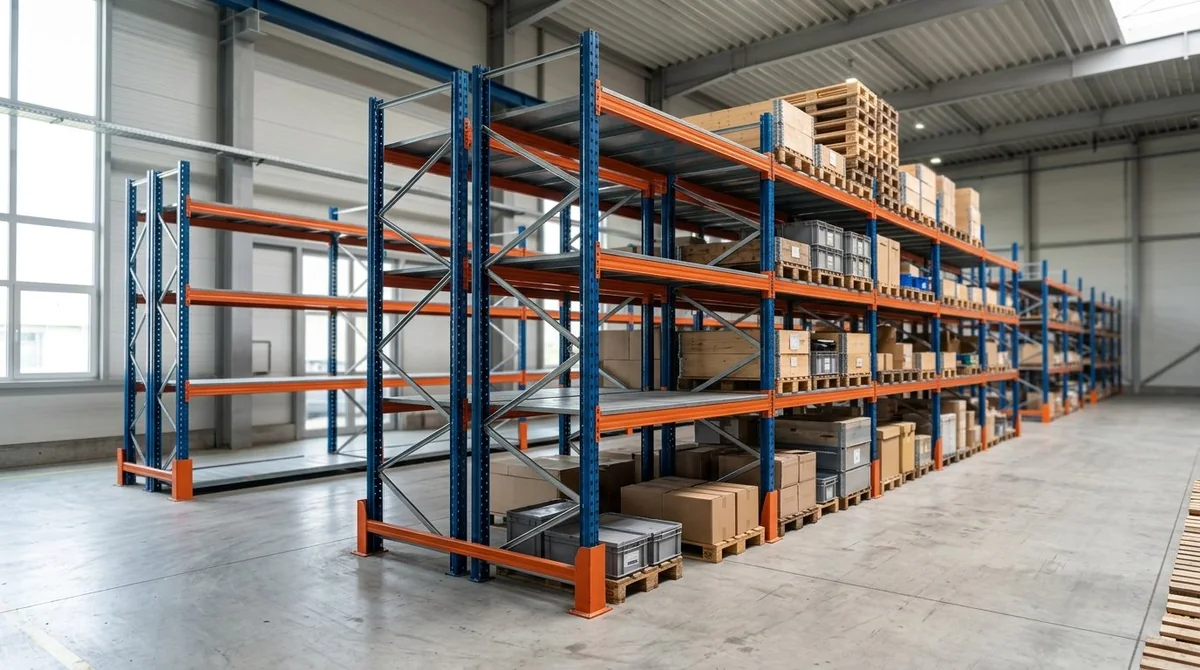
Purchasing industrial shelving is decided by three factors: the weight each level needs to support, the height it must reach, and whether the load is handled manually or by pallet. These factors narrow down the catalog to a specific range and then to two or three sizes. This guide walks you through this process, detailing the specifications for each range and outlining the applicable regulations.
The rackspoint catalog covers five families: light duty, medium duty, heavy duty, pallet racking, and workbenches. Cantilever, dynamic, and drive-in systems are not included here.
The Three Questions That Determine Your Purchase
What weight will each shelf level need to support?
The figure published by the manufacturer is the load per shelf with the weight evenly distributed across its surface. The total capacity is the sum of all levels: a four-level Titan Span at 800 kg provides 3,200 kg; a five-shelf Urban at 175 kg provides 875 kg. Consider the actual weight of what you will place on it, including packaging, and do not push the dimensions to the limit: if a level is to receive 180 kg, a shelf rated for 175 kg is not suitable.
Is the load handled manually or by forklift?
All shelving units with shelves, from light duty to heavy duty, are loaded manually, box by box. Only pallet racking is designed for a forklift to place entire pallets onto two beams. As a reference for the workplace, manual load handling guidelines set a recommended maximum weight under ideal conditions, and this maximum depends on grip height, frequency of handling, and the individual performing the lift. If your load unit requires lifting more than this criterion allows, it is no longer manual handling: you need pallet racking.
What height and depth fit in your space?
Shelving units with shelves range from 150 to 250 cm in height and 30 to 60 cm in depth. Pallet racking can reach 255, 300, and 353 cm in height, with a depth of 100 cm. Measure the actual clear height, subtracting light fixtures, ducts, and door swings, and ensure adequate aisle space: a workplace must comply with the minimum passage width stipulated by the applicable labor regulations in each country. For forklifts, the dimensioning criterion starts with the width of the vehicle or the largest load and adds a safety margin, which is even greater if traffic is two-way. These widths are valid only if no people are circulating in these areas; if pedestrians are present, a dedicated exclusive passage must be provided.
The Decision Tree, Step by Step
- Does the load come on a pallet and is it moved by forklift? Yes: K-PAL pallet racking systems, with 1,000 or 1,500 kg per level. No: continue.
- More than 400 kg per level? Yes: heavy-duty shelving, with 600 or 800 kg per shelf. No: continue.
- Between 175 and 400 kg? Yes: medium-duty shelving, from 200 to 300 kg per shelf and 400 kg for the stackable tire rack. No: continue.
- Less than 175 kg? Light duty: URBAN metal and white MDF at 175 kg; galvanized MDF and wire mesh at 150 kg.
- And if you also need to work on top? Workbenches at 240 and 250 kg per level and trolleys from 50 to 125 kg.
The Five Families with Their Specifications
Light Duty: Up to 175 kg per Shelf
- URBAN Metal: 180x90 cm with a depth of 30 or 40 cm; 5 shelves at 175 kg. Straight units from 1 to 4 modules, L-shaped, U-shaped, and corner units. The version with wheels is 180x90x60 cm, also at 175 kg.
- URBAN with MDF Shelf: the white unit measuring 180x90x40 cm maintains the 175 kg capacity; the galvanized units measuring 150x70x30 cm (5 shelves) and 160x80x40 cm (4 shelves) have a capacity of 150 kg.
- Wire Mesh: chrome-plated in 150x75x30, 180x90x40, and 180x120x45 cm; in black, only 150x75x30 cm. 5 shelves at 150 kg, from 1 to 4 modules.
Suitable for garages, storage rooms, and archives. Two material limitations, not regulatory: MDF is pressed fiber and chrome plating is a finish for dry indoor use; galvanized steel is noted for its moisture resistance. Wire mesh is for distributed loads, not for concentrated weight on a single point.
Medium Duty: 200 to 400 kg per Shelf
- SP ProSpan: 200x200x60 cm, 4 levels at 200 kg.
- SP ProRack: 180x120 cm with a depth of 45 or 60 cm, 5 levels at 275 kg.
- SP Pro Glide: 180 cm high, 120, 150, or 180 cm wide, and 60 cm deep, 4 levels at 300 kg.
- Tire Racks: the stackable unit measuring 200x200x60 cm, 4 levels at 400 kg, and the TyreRack measuring 200x150x45 cm, 3 levels at 300 kg.
Ideal for workshops, back rooms, and spare parts storage.
Heavy Duty: 600 and 800 kg per Shelf
- SP Titan C-Beam: 180x150x60 cm, 4 levels at 600 kg, 2,400 kg total.
- SP Titan Span: 250x200x60 cm, 4 levels at 800 kg, 3,200 kg total.
This is the limit for manual loading: 800 kg per level, placed one by one. Both units are assembled without screws, and their shelves are height-adjustable.
K-PAL Pallet Racking: 1,000 and 1,500 kg per Level
- Frames available in 255, 300, and 353 cm height, 100 cm depth.
- Beams available in 184 and 269 cm width, for two or three europallets per level.
- From 2 to 6 levels. Standard capacity at 1,000 kg per level; reinforced capacity at 1,500 kg, only available in the 269 cm width.
- Post protectors in L and U shapes, and aisle-facing upright guards.
Workbenches and Trolleys
- Compact workbench measuring 155x81x40 cm and a workbench with a panel and 2 drawers measuring 155x122x61 cm, up to 250 kg per level; a workbench with a panel and drawer measuring 150x120x60 cm, up to 240 kg.
- Tool trolley measuring 73x66x35 cm, 3 shelves at 50 kg.
- Service trolleys: 84x103x44 cm at 110 kg and 84x117x65 cm at 125 kg.
What Regulations Apply to Industrial Shelving, and Which Do Not?
This depends on two factors: pallet racking or shelving units, and whether it's a workplace or a private residence. The EN standards for design, specification, and use are the same across all European markets; what changes from one country to another is the labor legislation applicable to the workplace.
- Pallet Racking. Structural design follows EN 15512:2021+A1:2024; equipment specification follows EN 15629:2009; use and maintenance follow EN 15635:2010. Sector guidelines build upon the latter to establish technical criteria for occupational risk prevention.
- Shelving Units. EN 15512 expressly states it does not apply to manual handling units, and EN 15635 only partially covers other equipment. There is no European design standard for them: the sector code is FEM 10.2.06, from the industry and without regulatory status. What sector guidelines request is translated as a recommendation, never as an obligation.
- In a Workplace. Each country has its own regulations for work equipment and premises, which must be consulted where the installation is located. Work equipment regulations indicate that shelving «can be considered» work equipment, thus applying the criterion of assembly according to manufacturer's instructions when available, stabilization by anchoring if safety requires it, and, if such safety depends on the installation, initial and documented periodic inspections. Premises regulations govern the conditions of use.
- In a Garage or Storage Room of a Residence. No labor regulations apply: legislation on risk prevention applies to the scope of labor relations, and EN 15635 excludes domestic storage equipment. Manufacturer's instructions and technical judgment prevail.
Good Practice Criteria Applicable to Any System
The following are good practices for pallet racking and not standalone obligations; they are applied to shelving units as a matter of best practice, not as a regulation:
- Visible load signs, preferably at the end of the aisle: maximum load per level and per bay, distribution, and spacing between levels.
- Heavier items at the bottom: these good practices identify heavier loads on higher levels as a cause of overloading.
- No one should climb on the shelving: this is strictly prohibited and must be clearly signposted.
- Modifications must be done when empty and by qualified personnel. In pallet racking, changing the configuration requires the design responsible to recalculate and approve the new conditions.
- A plan for periodic inspections with anomaly recording. When rotation and working hours are very high, best practice suggests a reasonable minimum: daily checks by users, weekly and monthly checks by the supervisor, and an annual inspection by an independent expert.
- Anchoring: pallet racking is fixed only to the floor slab, not to walls or other structures, unless the design specifies otherwise. For shelving units, follow the manufacturer's instructions.
- Post protectors at least 400 mm high on uprights facing circulation aisles, tunnels, or dispatch areas.
When is it Advisable to Switch from Heavy Duty to Pallet Racking?
When the unit of load is a pallet. A Titan Span can support 800 kg per level, but with a 60 cm depth, a europallet will not sit properly; the K-PAL frame has a 100 cm depth for this reason. If goods arrive palletized and are moved by forklift, you need levels dimensioned for the entire pallet, forklift aisles, and floor anchoring. If the operator unpacks the pallet and places the boxes manually, heavy-duty shelving is less expensive and the correct choice.
Common Purchasing Mistakes
- Using an MDF board or chrome finish in areas with sustained humidity.
- Driving a forklift into the aisle of a shelving unit: its uprights are not designed for this.
If you are undecided between two ranges, choose the higher one: the price difference between 175 and 275 kg per shelf is small compared to shelving that cannot support the load.