Racks PointGo to the shop

Mobile Metal Shelving: Versatility for Your Warehouse
By Enrique Daroqui · · 3 min read
Mobile Metal Shelving: Versatility for Your Warehouse

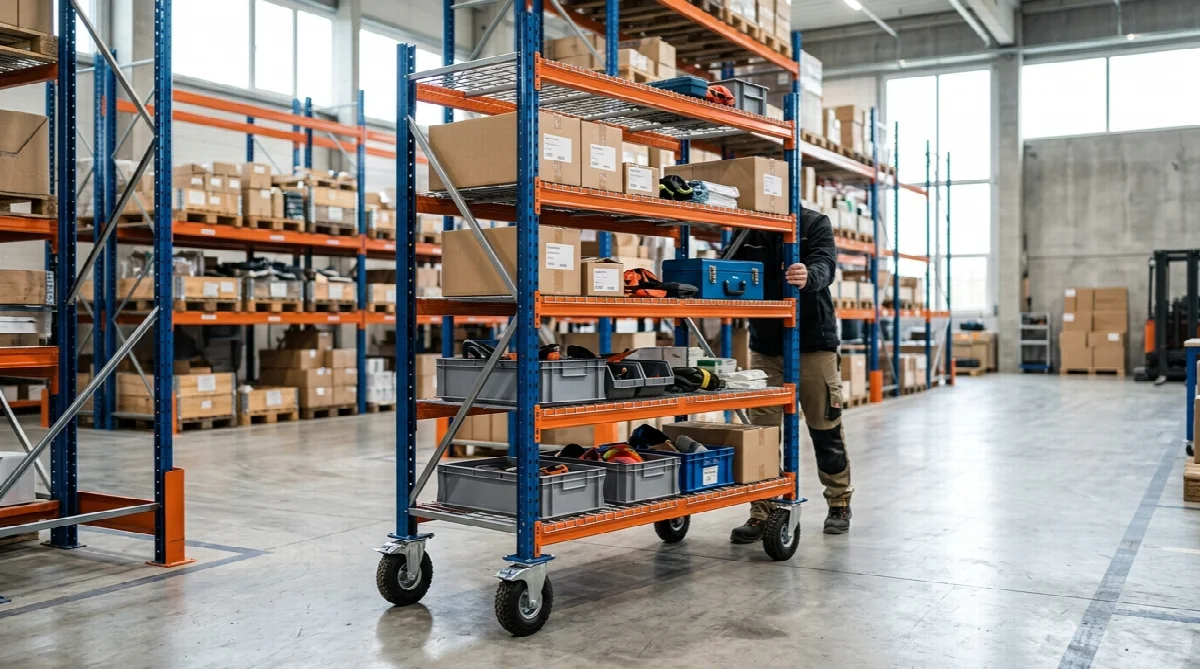
Mobile metal shelving has become the definitive solution for those needing a non-static storage system. Whether in an industrial setting, a professional workshop, or organizing a domestic storage room, the ability to move loads without prior unloading is a valuable asset that enhances productivity and order.

Unlike fixed pallet racking systems, mobile models allow for space reconfiguration in seconds. If you're looking for an agile solution, our mobile metal shelving with wheels offers the robustness of steel with the freedom of movement demanded by today's dynamic environments.

Advantages of Installing Mobile Metal Shelving

The primary advantage of this type of furniture is operational flexibility. In many warehouses, space is a limited resource; being able to move a loaded shelf allows access to hidden areas, facilitates deep cleaning, or adapts the workspace according to the goods being managed at any given time. Furthermore, by integrating this system, you avoid unnecessary physical effort and reduce order preparation times.

For larger projects, it's sometimes necessary to combine these mobile structures with fixed solutions such as custom-made metal mezzanines (industrial mezzanine), thereby achieving vertical and horizontal warehouse utilization. It's important to remember that when adding mobility, the quality of the casters and the locking system are crucial to ensure overall stability.

How to Choose the Right Mobile System?

Not all casters are the same. The choice directly depends on the load you will be supporting and the type of floor they will be moving on. Safety is non-negotiable: you should always opt for high-resistance casters with brakes to ensure the shelving remains immobile when not in use. If your load requirements are smaller, you can explore our light-duty shelving for garages and storage rooms, which are often the ideal starting point for domestic mobile configurations.

In summary, integrating mobility into your storage system is a smart investment. If you handle a high volume of products, remember that you can always complement your equipment with accessories and spare parts for pallet racking to ensure that every component, mobile or fixed, meets the necessary safety standards for your daily operations.
Category: Shelving with wheels
See products in this category →

Applicable regulations in Ireland

Shelving on castors (domestic use)

In Ireland, a shelving unit fitted in the garage, attic or utility room of a private home is not governed by workplace safety law: the Safety, Health and Welfare at Work Act 2005 and the General Application Regulations 2007 bind employers, not householders. What does apply is general product safety. Regulation (EU) 2023/988 (GPSR), applicable since 13 December 2024, requires that only safe products be placed on the market (art. 5) and that a distance-selling offer clearly shows the manufacturer's name, postal and electronic address and any safety warnings (art. 19); in Ireland it is enforced by the Competition and Consumer Protection Commission under S.I. No. 726/2024, which also requires that this information, and the safety information supplied with the product, be in English (Reg. 5).. The Consumer Rights Act 2022 adds that goods must come with the installation instructions a consumer may reasonably expect (s. 18) and that an incorrect installation due to shortcomings in those instructions is a lack of conformity (s. 19). Our advice: lock the castor brakes while loading and unloading and whenever the unit is in place, move it only across smooth, level floors, never exceed the stated maximum load per shelf and keep heavy items at the bottom.

Professional use with manual loading

In Ireland, shelving in a workshop, shop or stockroom with employees is work equipment: the Safety, Health and Welfare at Work (General Application) Regulations 2007 (S.I. No. 299/2007) define that as any installation for use at work (Reg. 2) and set the employer’s duties in Part 2, Chapter 2, giving effect to the EU Work Equipment Directive, now codified as Directive 2009/104/EC: installed and located correctly and suitable for the work (Reg. 28); stabilised by clamping or some other means where necessary for safety (Reg. 33), for a tall unit fixed to the wall; kept safe by adequate maintenance throughout its working life (Reg. 31); and erected or dismantled following the manufacturer’s instructions (Reg. 28(o)). Because a bolted unit’s safety depends on how it is installed, Reg. 30 requires an initial inspection after installation and after re-assembly at any new location, plus periodic inspections by a competent person where it is exposed to conditions causing deterioration, with results kept for 5 years. The Health and Safety Authority’s Work at Height / Falling Objects information sheet asks for the maximum safe load prominently marked on all racks, no overloading, and racking checked regularly for damage and not used until repaired or replaced. EN 15635, the European standard on use and maintenance, is a reference, not a legal obligation.

Guidance based on current regulations; it does not replace the legal text or professional advice. · Last checked: 2026-09-08

Keep reading

Industrial Shelving: The Complete Guide to Optimizing Your WarehouseHeavy-Duty Racking: Your Ultimate Warehouse GuideElevated Intralogistics: Optimize Your Warehouse Load Flow
← Back to blog