Wire Mesh Racks: Load Capacity, Finishes, and Regulations
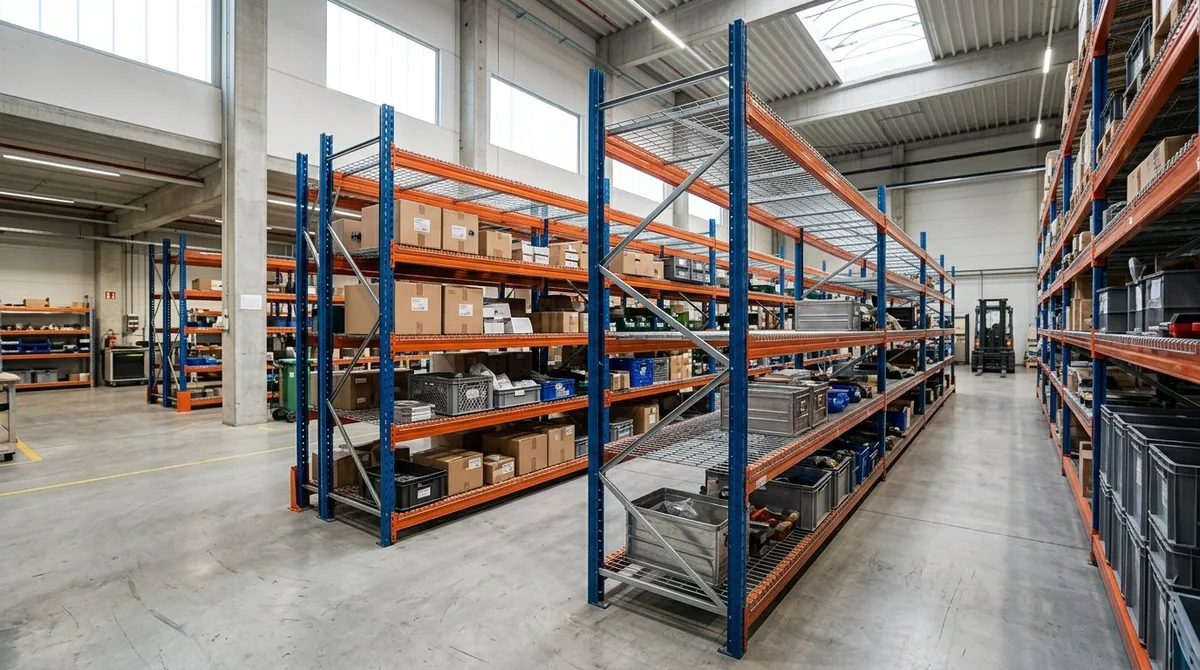
A wire mesh rack is a complete shelving unit: four steel posts and wire shelves adjustable in height, which slot together without screws and are loaded by hand. At rackspoint, we offer four models from the URBAN light-duty range, with a load capacity of 150 kg per shelf.
Why Do "Wire Mesh Racks" Refer to Two Different Products?
Because the English term has two meanings. In the British and American sectors, "wire mesh decking" refers to the mesh panel placed on the beams of a pallet rack to prevent items from falling through the structure. This is how the RMI, the US industry association, describes it, and the British SEMA published a code of practice solely for these panels in 2024. A complete rack with posts and wire shelves is called wire shelving, and in German, the shelf is the Gitterboden. This guide focuses on the latter: rackspoint does not sell mesh panels for K-PAL palletization.
What Sizes and Load Capacities Per Shelf Are Available in the Catalogue?
Four models are available, ranging from one to four aligned modules, all with the same stated load capacity:
- Chrome Mesh 150 × 75 × 30 cm: 150 kg per shelf.
- Black Mesh 150 × 75 × 30 cm: 150 kg per shelf.
- Chrome Mesh 180 × 90 × 40 cm: 150 kg per shelf.
- Chrome Mesh 180 × 120 × 45 cm: 150 kg per shelf.
The dimensions are height, width, and depth. The manufacturer states the load per shelf, distributed across its entire surface, not a total per module. The number of levels is indicated in the product sheet and instructions. These are available in wire mesh shelving.
How Much Weight Can a 150 kg Shelf Actually Hold?
The 150 kg capacity is valid for loads uniformly distributed across the entire shelf surface, referred to as UDL in English product sheets. This is the standard entry-level figure for the European market, where reinforced ranges can go up to 250 kg and even 360 kg per shelf. No regulation specifies a minimum load; each manufacturer declares it, and it's crucial to understand the conditions under which it applies.
Why Does Load Distribution Affect the Result?
Because mesh is dimensioned this way. The pallet racking sector, which uses similar panels, states it more bluntly: capacity is defined only for distributed loads, and a concentrated load can cause the panel to bend, buckle, or fail, even if the total weight is below the stated figure. Heavy and compact items should be placed on the lower shelf and close to the posts, or on a plank that distributes the weight.
When to Choose Mesh Shelving and When to Choose Solid Shelving?
Mesh shelving excels where light, air, and cleanliness are important, and falls short when dealing with small parts or dripping liquids. Advantages:
- Visibility and Light: Light passes through the levels, allowing you to see what's stored above.
- Air Circulation: Reduces dust and moisture on stored items.
- Less Dirt: Dust and small debris fall through the gaps.
- Sprinklers: Water can pass from one level to the next, according to manufacturers. This is a warehouse feature, not a garage one, and no fire regulation mandates it.
Disadvantages:
- Doesn't Secure Small Items: Screws, bottles, or caps can fall through the gaps; this can be resolved with boxes or shelf liners.
- Doesn't Contain Liquids: Spills from above will reach the shelf below and the floor. A drip tray is needed under a leaking container.
- Not for Standing On: Industry experts state that mesh panels are not designed for people to stand on, and a light-duty shelf warrants no greater confidence.
How Does it Differ from the URBAN Metal Shelf Unit?
The solid shelf retains what the mesh lets through. The URBAN metal shelf unit measures 180 × 90 cm with depths of 30 and 40 cm, and 60 cm in the wheeled version. It has five levels with a capacity of 175 kg per shelf. Its versions with MDF shelves, measuring 150 × 70 × 30 cm and 160 × 80 × 40 cm, have a capacity of 150 kg. For boxes, clothing, or packaged goods, choose mesh; for screws, bottles, or loose tools, opt for solid shelving. Both are available in light-duty shelving.
Which Finish to Choose: Chrome, Black, or Galvanized?
The 150 × 75 × 30 cm model is the same unit in two finishes, chrome and black. Galvanized is a different product, with a solid shelf. There is no official source comparing finishes; this is based on industry experience.
Chrome and Black: Only for Dry Environments
Manufacturers of wire shelving recommend chrome for dry storage rooms, offices, garages, shops, pantries, and workshops, and advise against it in humid environments. One manufacturer warns that it tends to rust where frequent water cleaning occurs. Black is not chrome but steel with powder coating, and is advised against in the same way: choose it for aesthetics, not for moisture resistance. Our catalogue does not specify the nature of this coating, so please ask us before placing it in a damp area. There is a common misconception: epoxy coating, which resists water, aggressive cleaning agents, and cold, is protective as long as it is intact—if scratched, the metal is exposed. Stainless steel is ideal for wet environments. Neither of these finishes is available for our mesh shelving.
Galvanized: Solid Shelf for Dripping Contents
The zinc in galvanization resists rust and corrosion and is the finish of the Urban galvanized unit, measuring 180 × 90 cm, with a solid shelf capable of holding 175 kg per level. It functions differently from mesh shelving: nothing can fall through to the level below. Containing a spill requires a raised edge; check the product sheet for details.
Is a Chrome Shelf Unit Suitable for a Professional Kitchen or a Cold Room?
For the dry storage area of a kitchen, yes; for a cold room or washing area, no. The reason is not a regulation prohibiting chrome, but humidity: hospitality shelving manufacturers do not recommend it in cold rooms. Food safety regulations require:
- Regulation (EC) No 852/2004, in Chapter V of Annex II, stipulates that equipment in contact with food must be easily cleanable and its installation must allow for the cleaning of the equipment and the surrounding area; this does not apply to the domestic storage of food for private consumption.
- Regulation (EC) No 1935/2004 governs materials that come into, or can reasonably be expected to come into, contact with food: a shelf supporting closed containers is not considered to be in direct contact; if food were placed directly on it, then it would be. The European Commission does not publish specific measures for metals; in such cases, national regulations of each Member State apply.
- Therefore, we do not sell them as suitable for direct food contact: store packaged goods. The "NSF" mark advertised by some sellers is a private US scheme not required by these regulations.
Do Wire Mesh Racks Need to Be Anchored to the Wall?
It depends on the ratio between its height and depth, and what you store on the top shelf. A German wire mesh rack manufacturer publishes this rule: when the height exceeds five times the depth, it must be secured against tipping with floor or wall fixings. Dividing the total height, which is the most demanding measurement:
- 150 × 75 × 30 cm: 150 divided by 30 equals 5.0. Exactly at the limit.
- 180 × 90 × 40 cm: 180 divided by 40 equals 4.5.
- 180 × 120 × 45 cm: 180 divided by 45 equals 4.0.
This ratio is a manufacturer's guideline, not a binding regulation. Our recommendation: anchor if the instructions indicate it, if the top shelf is heavily loaded, if children are present, or if the floor is uneven. Place heavier items at the bottom, level the feet, and do not use the unit as a ladder.
Can I Expand a Wire Mesh Rack After Purchase?
Yes. They are sold in one, two, three, or four modules, and an additional module added later is the same product; the load capacity also remains unchanged: 150 kg per shelf, distributed. Level them all and, if the top shelf is heavily loaded, fix it to the wall. Note how they connect to each other: the same manufacturer reduces the shelf load from 250 kg to 100 kg when an added module is hung with S-hooks.
What Regulations Apply to Wire Mesh Racks, and Which Do Not?
The European standards often cited in this context pertain to different products:
- EN 15512, on structural design, applies only to conventional pallet racking and not to manual loading.
- EN 15635, on the use and maintenance, is for systems served by handling equipment and excludes domestic storage.
- EN 15629 does mention manual load shelving, but also excludes domestic use; EN 15878 merely defines them.
- The only specific design code for manual loading is FEM 10.2.06, a paid industry document that is not an EN standard.
What Governs a Home Garage, Storage Room, or Pantry?
General product safety regulations apply, not industrial shelving standards. Regulation (EU) 2023/988, applicable from December 13, 2024, mandates that only safe products can be placed on the market and that manufacturers must provide clear safety instructions and information (Article 9.7). Within the European Union, national regulations on work equipment and occupational safety and health govern employment relationships; general consumer protection legislation requires instructions for use and warnings of foreseeable risks on labelling (Article 18).
What About a Shop, Workshop, or Warehouse with Employees?
When employees are involved, shelving may be considered work equipment. This requires assembly according to the manufacturer's instructions, an initial inspection after installation, periodic checks with frequencies specified in the manual, stabilization by anchoring when necessary, and maintenance in accordance with the instructions. In EU countries, regulations on work equipment and occupational safety and health set out these checks and requirements, defining work equipment as any machine, apparatus, tool, or installation used at work (Article 2) and establishing these checks (Article 4). Industry guides confirm that shelving can be considered work equipment. In other countries, their own labour regulations apply, with the same requirements: structural integrity for the intended load, appropriate anchoring, adherence to the maximum permissible load, and placing heavier items at the bottom, as summarized in material storage guides.
Best practice guides, not mandatory standards, deal with pallet racking; from them, two key takeaways are important: standing on shelves is strictly forbidden, and placing heavier loads on upper levels is a common cause of overloading. Industry criteria for hand-loaded shelving suggest securing them against tipping when the height exceeds five times the depth, but measured to the last loaded shelf, not the top frame. The maximum recommended weight for manual lifting is not a single figure; it depends on the grip height, frequency, and the individual. Avoid lifting loads above head height: on a 180 cm shelf, this determines what goes on the top shelf.
Pre-Purchase Checklist
- Weigh the heaviest items you intend to store and compare them to the 150 kg per distributed shelf.
- For dry environments: choose chrome or black. For water, splashes, or cold: opt for solid galvanized shelves.
- Divide the height by the depth and anchor if the instructions recommend it.
- For small items or dripping contents: plan for boxes, liners, or drip trays.
- Keep the instructions: with employees, they are the reference for assembly and maintenance.
All four models are available in wire mesh racks.