Industrial Pallet Racking: A Guide for Your Warehouse
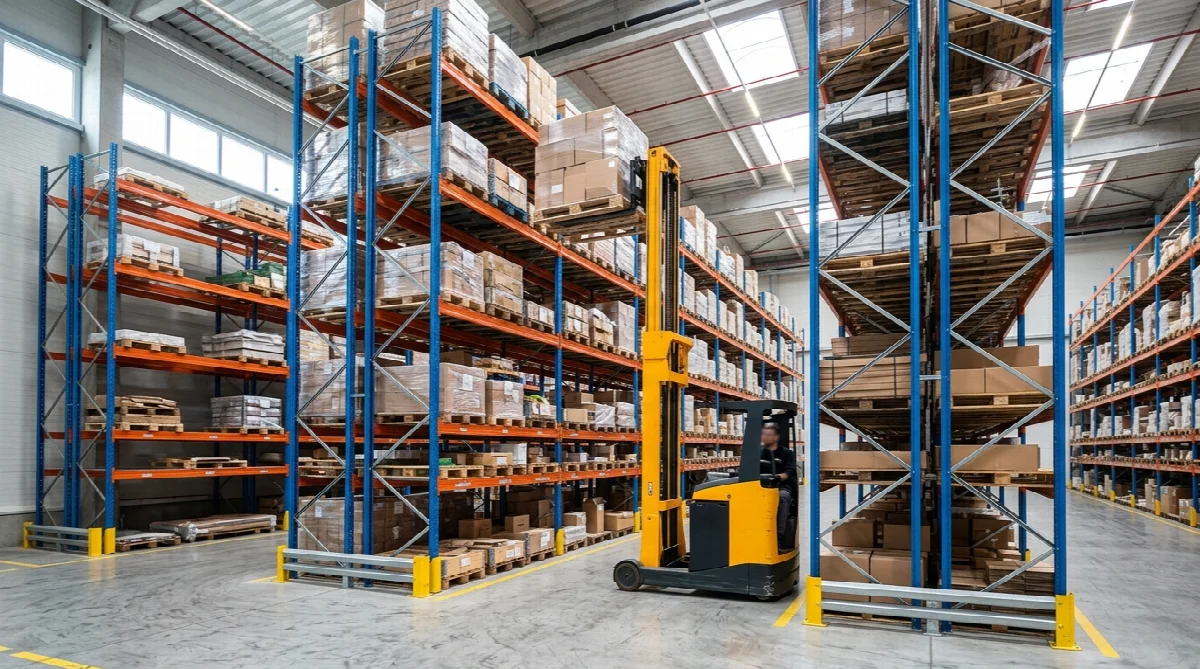
Have you ever felt like your warehouse is too small because goods are taking up all the floor space? Lack of verticality is the primary enemy of efficiency. In the video above, Mario Rack explains how proper management of vertical space allows forklifts to move freely, transforming a floor-level storage system into one that utilizes every available meter up to the ceiling.
What is Pallet Racking and When is it Worthwhile?
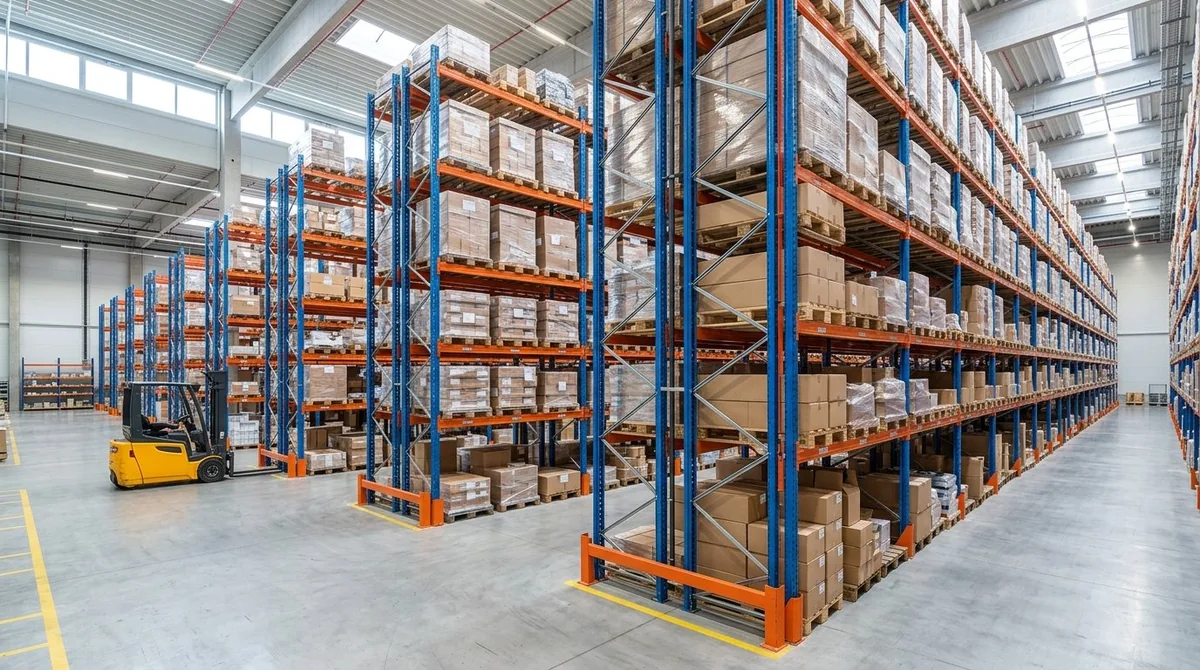
Industrial pallet racking is a steel structure composed of vertical frames and pairs of horizontal beams. Each pair of beams forms a load level onto which a forklift places a pallet. In the K-PAL family, a complete module consists of two frames plus the beam sets for its levels; this alignment is extended with individual frames and beams, also sold as components.
The decision between pallet racking and heavy-duty shelving with shelves hinges on how goods are handled. If entire pallets are moved in and out by forklift, palletization is the ideal solution: the level is sized for the weight of a full pallet. If operators pick individual boxes, shelving with continuous shelves is required.
How to Size It: Height, Width, Depth, and Levels
By Warehouse Height
- Frames available in 255, 300, and 353 cm heights.
- Frame depth: 100 cm, suitable for the 800 x 1,200 mm Euro pallet supported on the two level beams.
The height selection isn't solely based on the warehouse height: industry best practices recommend that the outer frames should extend above the top load level. A common-sense check also applies: the highest beam must be within the lifting range of your forklift.
By Pallets Per Level
- 184 cm beam: accommodates two Euro pallets per level.
- 269 cm beam: accommodates three Euro pallets per level.
The 800 x 1,200 mm Euro pallet is manufactured according to EN 13698-1 and is the standard reference unit throughout Europe. If your pallets have a different footprint, please specify this before requesting a quote.
By Number of Levels
Each module can accommodate between 2 and 6 load levels. The spacing between levels is determined by the height of the loaded pallet plus clearance for maneuvering, and this information is stated on the rating plate: altering it later requires recalculation and written approval from the designer.
How Much Weight Can Each Load Level Support?
This depends on the beam. The figure is always per level (pair of beams) with the load uniformly distributed across both beams:
- STD, 100 mm profile beam: 1,000 kg per level. Available in both 184 cm and 269 cm widths.
- REF, 120 mm profile beam: 1,500 kg per level. Only available in the 269 cm width.
Translated to pallets, with equal weight distribution: two Euro pallets on a 184 cm STD level, up to 500 kg each; three on a 269 cm STD level, approximately 333 kg each; three on a 269 cm REF level, 500 kg each. The pallet itself counts: approximately 25 kg for a wooden Euro pallet, according to EPAL. If your pallets weigh more, the solution is the reinforced 300 x 269 cm pallet racking with four levels or distributing the load across more modules.
"Uniformly distributed" is crucial: a load concentrated in the center of the beam stresses the profile approximately twice as much as the same load distributed along its entire length. This is why the rating plate, preferably located at the rack ends, must indicate the maximum loads per level and per frame, their distribution, and the spacing between levels. The load per frame depends on the configuration and is determined by the installation's engineering calculations.
How to Choose the Forklift and Aisle Width
The aisle width is determined by the forklift, not the racking. This is known as the working aisle width (Ast) and is found in the technical specifications of each model. The following rules apply:
- The workplace regulations in your country specify a minimum aisle width and usually require that pathways shared by vehicles and pedestrians allow for simultaneous passage with sufficient separation. Verify the applicable figure before designing the installation.
- The calculation is as follows: for a single-lane pathway, the width of the forklift or the largest load plus a maneuvering margin; for a double-lane pathway, a larger margin, provided no pedestrians are present. If pedestrians are present, an exclusive and clearly marked pedestrian zone must be added. Calculations are based on the largest forklift.
As a guideline from industry manuals, and only for magnitude estimation: a counterbalanced forklift typically requires over 3 meters; a reach truck, between 2.7 and 3 meters; a very narrow aisle truck, less than 2 meters. The valid figure for your risk assessment is from your forklift's specifications. Forklift operation is restricted to individuals with specific training.
In-Use Safety: What EN 15635 Requires
The European standard for the use and maintenance of metal racking is EN 15635, adopted by each country with its own national prefix. While voluntary, national safety organizations build their guides upon it: in your country, industry guides offer detailed information and calculation tools.
The Person Responsible for Storage Equipment Safety (PRSES)
EN 15635 dedicates a section to the Person Responsible for Storage Equipment Safety (PRSES), appointed by warehouse management. Like the inspector, this individual assesses and classifies damage.
Inspections and Damage Colors
Best practice calls for a plan of periodic inspections with anomaly logging. In high-turnover and high-usage environments, at a minimum, a daily visual inspection by staff (checking for deformations, verticality, anchors, clips, plates), a weekly inspection, and a monthly inspection by the warehouse manager are recommended. An annual inspection by an independent expert is also advised.
Damage is classified into three levels, measuring permanent deformation in the center of a 1-meter section:
- Green: Below the following limits; only requires maintenance.
- Amber: Upright bent 3 mm or more in the frame plane, 5 mm or more in the beam plane, or 10 mm or more in the bracing, without reaching double the limit. The affected area must be unloaded and repaired as soon as possible. If not repaired within the timeframe specified by the EN 15635 diagram, or if the damage has worsened, it escalates to red.
- Red: Double or more than the specified values. Immediate unloading of all modules and repair before reuse.
Damaged components must be repaired or replaced with identical ones; never by heat (welding), as this alters the steel's mechanical properties.
Post Protectors and Barriers
The primary defense against forklift impacts is prevention (training, clear aisles, visibility, signage), and the secondary is absorption. Best practice mandates post protectors of sufficient height, with a minimum energy absorption capacity specified by EN 15635. These should be installed on the end posts of each row and at aisle intersections. In the K-PAL catalogue, you'll find the L-shaped post protector, the U-shaped protector, and the protection barrier, all bolted to the floor. Consult us to determine which protector best suits your risk assessment.
Anchoring and Assembly
Racking must be fixed solely to the concrete slab, never to walls or other building structures, unless indicated in the design documentation. Before assembly, the supplier and user must jointly inspect the slab. The completed installation must comply with the tolerances specified in EN 15620. In K-PAL systems, each beam engages with the frame using a connector and a safety pin. EN 15635 requires a safety device on each connector to prevent the beam from disengaging with an accidental upward pull; if you require the calculation value for your risk assessment, please consult us.
Applicable Regulations: What is Mandatory and Where
It's important to distinguish between mandatory requirements and recommendations, and to specify the country where they apply: the European framework is common to all markets, while workplace safety legislation is national. European standards are common across all markets; your country will have its own equivalents to the directives and regulations.
- The national Health and Safety at Work Act in each country obliges employers to ensure the safety of their workers and to conduct an initial risk assessment, which includes racking.
- The national regulations on work equipment and health and safety at work, which transpose Directive 2009/104/EC, consider racking as work equipment. Therefore, they mandate initial checks after installation, periodic checks if the equipment may deteriorate, and prohibit overloading and use under conditions contraindicated by the manufacturer.
- The national workplace regulations: these specify a minimum aisle width, a "sufficient" separation between vehicles and pedestrians, and a minimum illumination level in commonly used traffic routes. Each country sets its own values in its equivalent regulations.
- Industry guides: these are references for best practices, not legally binding in themselves; they provide the specific figures for aisles, protectors, and inspections used in warehouses.
- EN Standards, which are voluntary and common throughout the European market: EN 15512 (structural calculation), EN 15620 (tolerances and clearances), EN 15629 (data provided by the buyer to the designer), EN 15635 (use and maintenance), and EN 15878 (terms and definitions).
Across the entire European Union, Directive 2009/104/EC, transposed into national law in each country, follows the same framework: initial inspection, post-assembly checks, and periodic inspections by competent persons. The specific national regulation number may vary, but the substance remains the same.
Frequently Asked Questions
How often should pallet racking be inspected?
The work equipment regulations, which transpose Directive 2009/104/EC in each country, require periodic checks without a fixed calendar and refer to the manufacturer's manual. The technical reference, common to all markets, is EN 15635. Industry practice combines four levels of inspection: daily, weekly, monthly, and an annual inspection by an independent expert in high-turnover warehouses. Damage classified as green is logged and reassessed during the next inspection, which, according to the EN 15635 diagram, should occur within the following 12 months.
What should I do if a forklift hits a frame?
Measure the permanent deformation with a 1-meter ruler placed against the upright and classify the damage according to the thresholds above: green, maintenance required; amber, unload the area and repair or replace the element with an identical one within the timeframe specified by EN 15635; red, unload the entire rack immediately. Never use welding.
In-House Manufacturing and How to Request a Quote
We manufacture our own pallet racking systems; product specifications are based on the K-PAL catalogue. To provide a quote, we require the data specified by EN 15629 for the buyer:
- Free height of the warehouse and slab condition.
- Load unit: pallet type, maximum loaded weight, and total height.
- Forklift: model, working aisle width (Ast), and lifting height.
- Pallets per level, levels per module, and planned extensions.
With this information, we will advise whether your configuration requires STD or REF beams and how many 184 cm or 269 cm modules can fit in the row. All combinations are available in the pallet racking systems category.